
Are pre-engineered steel buildings durable? Detailed explanation & outstanding advantages.
As the demand for industrial and commercial construction continues to rise, pre-engineered steel buildings have become a preferred solution thanks to their fast construction speed, high durability, and flexible customization.
With many years of experience in steel structure design, manufacturing, and construction, we provide comprehensive solutions that meet international quality standards and diverse customer requirements.
1. Are Pre-Engineered Steel Buildings Durable? – Quick Answer
Yes. Pre-engineered steel buildings are extremely durable, with an average lifespan of 40–70 years, or even longer when properly designed, fabricated, and erected according to technical standards.
Modern steel structures are strong, stable, and highly resistant to deformation—making them ideal for factories, warehouses, logistics centers, multi-story buildings, showrooms, and more.
2. Five Key Factors that Determine the Durability of Pre-Engineered Steel Buildings
2.1 Superior Load-Bearing Capacity of Steel
Steel offers much higher tensile and compressive strength than concrete, helping it:
Support heavy loads
Avoid cracking like concrete
Maintain shape under wind and seismic forces
This is especially crucial for large-scale industrial buildings or high-load structures.
2.2 Technical-Standard Design – The Most Critical Factor
Design quality determines 60–70% of a building’s durability.
A standard design must include:
Accurate calculations of dead loads and wind loads
Structural optimization for each component
Proper placement of frames, purlins, and bracing
Safety checks based on Vietnamese and international codes
For large industrial projects, structural simulation using specialized software is mandatory to ensure long-term stability.
2.3 Excellent Corrosion Resistance
Modern PEB systems apply:
Anti-rust paint
2–3 layer epoxy coating
Hot-dip galvanizing for coastal or chemical environments
These protective systems shield steel from:
Oxidation
Humidity-induced corrosion
Chemical or salt contamination
With proper maintenance, the lifespan can exceed 70 years.
2.4 Fire Protection Solutions – Enhancing Safety and Durability
Although steel loses strength at high temperatures, modern solutions help maintain structural safety:
Fire-resistant coatings
Thermal insulation wraps
Fire-rated wall/roof panels (EI 60–EI 120)
These methods ensure compliance with fire safety codes for factories, cold storage facilities, and multi-story buildings.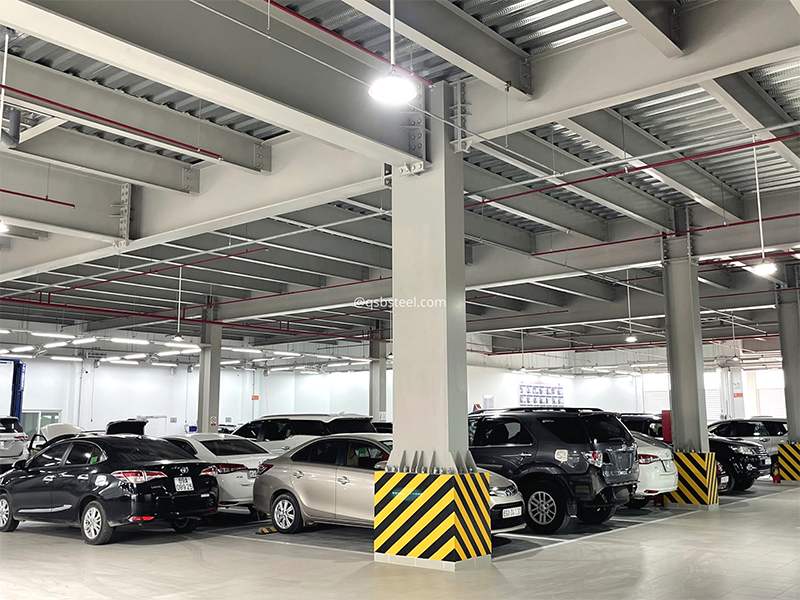
2.5 Standardized Construction & Installation Process
A proper PEB construction workflow includes:
CNC fabrication at the factory
Bolt, weld, and dimensional inspection prior to delivery
Professional on-site erection
Stage-by-stage quality acceptance


Common issues in low-quality installations include:
Misaligned joints
Under-tightened bolts
Incorrect welding
Insufficient paint thickness
Even small errors can reduce durability. With correct installation, longevity and stability are significantly improved.
3. Are Steel Buildings More Durable Than Traditional Concrete? – Practical Comparison
| Criteria | Pre-Engineered Steel Building | Reinforced Concrete Building |
|---|---|---|
| Lifespan | 40–70 years | 50–80 years |
| Load-bearing | Excellent | Medium |
| Deformation resistance | Good | Low |
| Construction speed | Fast | Slow |
| Expansion capability | Easy | Difficult |
| Maintenance | Easy | Medium |
Conclusion: Steel buildings are completely durable, often outperforming concrete in many real-world applications.
4. How to Ensure Maximum Durability for a Pre-Engineered Steel Building?
Durability depends on several controllable factors during design and construction.
4.1 Selecting the Right Steel Grade
Buildings with high loads or multiple floors require steel that offers:
High strength
Good ductility
Excellent bending and torsional resistance
Steel grades such as Q345 or Q355 are widely preferred for large-scale industrial projects.
4.2 Choosing the Proper Coating or Galvanizing System
Each environment requires a specific protection solution:
| Environment | Recommended Protection |
|---|---|
| Normal | Anti-rust + 2-layer epoxy |
| Industrial zone | Epoxy + PU |
| Coastal areas / high humidity | Hot-dip galvanizing |
| Chemical factories | Chemical-resistant coating |
The coating system affects the structure’s lifespan by 10–20 years.
4.3 Optimized Design to Reduce Unnecessary Loads
Modern design techniques allow:
Optimized beam and column profiles
Optimized column spacing
Reduced roof load
Improved overall stability
A skilled designer not only increases durability but also reduces material costs by 5–15%.
4.4 Strict Quality Control at the Factory
Durability can be compromised by:
Dimensional inaccuracies
Welding defects
Improper surface cleaning
Insufficient coating thickness
Factory-level QC ensures quality from the very beginning.
4.5 Standardized On-Site Installation
Installation is the highest-risk phase. Even small issues such as:
Incorrect bolt torque
Misaligned columns
Outdoor welding without protection
can seriously affect longevity and safety.
A proper erection process must include:
Detailed method statements
Professional supervision
Component-by-component approval
Full construction logs
4.6 Regular Maintenance for Long-Term Durability
Regardless of strength, steel still requires scheduled maintenance:
Repainting every 5–7 years
Checking bolts and bracing systems
Cleaning roof gutters
Inspecting moisture-prone areas
Proper maintenance can extend structural lifespan by 15–20 years.
Conclusion
Pre-engineered steel buildings are highly durable, long-lasting, strong, and suitable for all types of modern construction. Durability depends on material quality, design standards, corrosion protection, installation, and maintenance. When these factors are ensured, a steel building can operate safely and efficiently for 40–70 years or more.
Hotline for Export Steel Structure Quotation: Click here
 Learn more: Latest Cost Estimates for Pre-Engineered Buildings

📞 Hotline: (+84) 918 23 23 65
📧 Email: mkt@qsbsteel.com
🌐 Website: https://qsbsteel.com/
👉 Contact QSB Steel today for expert consultation and the most suitable solutions for your project! 🚀
- Summary of typical projects implemented by QSB STEEL in 2020
- Office house – 02 Tekcom Factory
- Project: Welcome Gate PHU MY 03
- Are pre-engineered steel buildings in coastal areas durable? Solutions for corrosion and storm resistance.
- Training session on fire-resistant paint for steel structures at QSB Steel
- URC VIETNAM FACTORY PROJECT
- Steel Plate Manufacturing: Common Defects and Applications
- ASSEMS Korea factory
- How to effectively manage construction project costs?
- Corrosion-Resistant Pre-Engineered Steel Buildings – Expert Design Insights
Related news:

Heavy Steel Structures: Common Applications in Modern Industrial Projects
-
What Is Steel Surface Shot Blasting? Is It Mandatory?
Essential Steel Structure Components for Industrial Buildings
Heavy Steel Components at QSB STEEL: Large-Scale Steel Fabrication Capability
ISO 45001 Occupational Health and Safety Management System in Heavy Steel Structure Construction Projects
Updated Prefabricated Steel Building Construction Price Quote 2026
-
Steel Plate Manufacturing: Common Defects and Applications

Food Processing Steel Factory Design: Ensuring Hygiene Standards and Production Efficiency