Common Terms & Stages in Steel Structure Fabrication
In the industrial construction sector, steel structures play a vital role in forming factories, warehouses, bridges, towers, and more. However, for those new to the field, technical terms such as CNC, welding, bending, or shot blasting may sound unfamiliar.
This article helps you understand each stage of the steel structure manufacturing process, as well as the most common industry terms.
1. Common Terminology in Steel Structure Fabrication
1.1 Material Inspection and Preparation
The main materials are steel plates, structural steel sections, and steel pipes. Before production, the QA/QC team inspects the chemical composition, mechanical properties, and mill certificates. This step is crucial to ensure compliance with standards.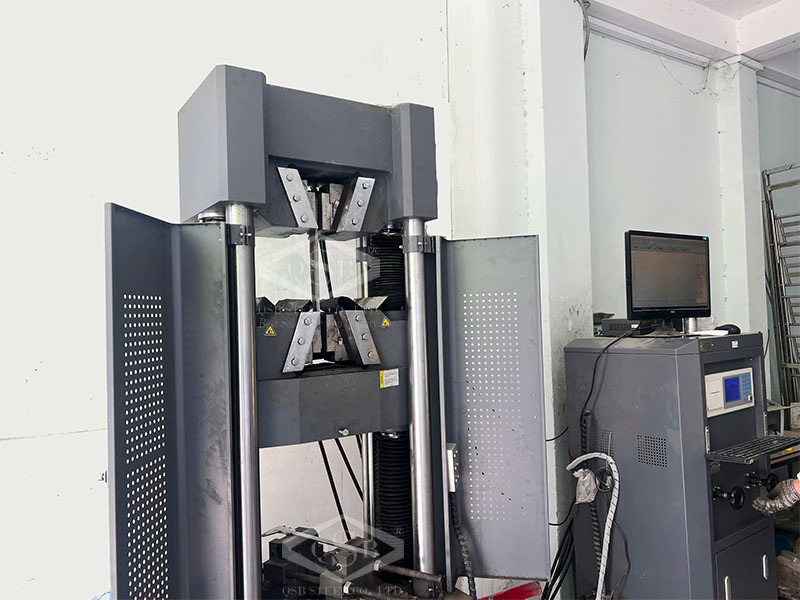
1.2 CNC Cutting / Plasma Cutting / Oxy-fuel Cutting
CNC Cutting (Computer Numerical Control): Automated cutting based on CAD drawings with high precision.
Plasma Cutting: Suitable for medium-thickness steel plates.
Oxy-fuel Cutting: Commonly used for thick steel plates.
Common terms: CNC cutting, nesting, oxy-fuel cutting.
1.3 Drilling – Punching – Edge Cutting
At this stage, bolt holes are drilled or punched using specialized machines. Edges are ground smooth to prepare for welding and assembly.
1.4 Assembly
Steel plates after cutting/drilling are assembled into beams, columns, or base plates. Jigs are used to ensure correct dimensions.
Common terms: assembly, jigging, shop drawing.
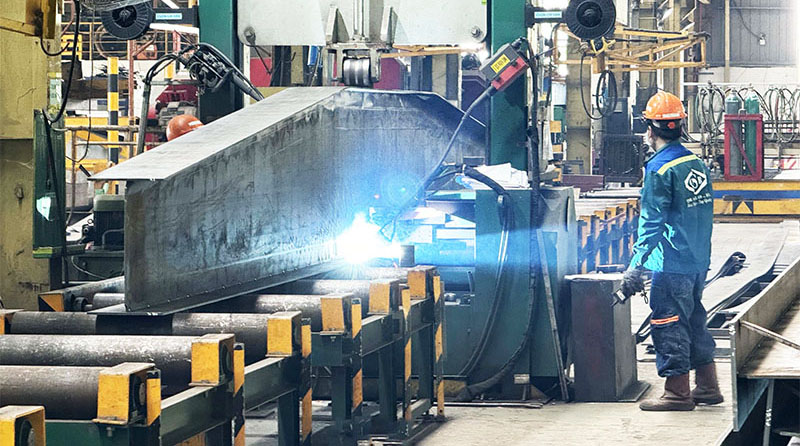
1.5 Welding
This is one of the most critical stages:
Manual Arc Welding (SMAW)
Semi-automatic MIG/MAG Welding
Submerged Arc Welding (SAW)
Welds must ensure penetration, free from porosity or cracks.
Common terms: welds, welding electrodes, filler material, NDT (Non-Destructive Testing).
1.6 Straightening – Distortion Control
After welding, steel parts may deform. Straightening machines and hydraulic presses are used to restore accurate dimensions. Although often overlooked, this step is essential to ensure precise erection.
1.7 Grinding – Weld Cleaning
Welds are ground and smoothed for safety and aesthetics before painting.
1.8 Shot Blasting / Sand Blasting
This process cleans the steel surface with small steel shots or high-pressure sand.
Purpose: Remove rust, oil, and scale while improving paint adhesion.
Standards: SA 2.0 – SA 2.5
Common terms: surface preparation, blasting profile, SA standard.
1.9 Anti-corrosion Coating – Finishing Paint
Typically, steel structures are painted in 2–3 layers:
Primer: Epoxy anti-corrosion coating
Topcoat: Epoxy, PU, or fireproof paint
Common terms: coating system, DFT (Dry Film Thickness), epoxy primer.
1.10 Quality Control (QC)
Final inspection before delivery:
Dimensional and tolerance checks
Weld inspection (UT – Ultrasonic, MT – Magnetic Particle, RT – Radiographic)
Paint thickness, adhesion, and color check
Common terms: QC, NDT, inspection report.
 See more: Quality & Safety at QSB Steel
 S
1.11 Packing – Delivery – Transportation
Finished steel components are packaged, labeled, and delivered to the construction site for erection.
Conclusion
The steel structure fabrication process combines advanced technology with skilled craftsmanship. Understanding terms such as CNC, welding, shot blasting, and anti-corrosion painting helps investors, engineers, and clients better grasp the process and select the right fabrication partner.
With hands-on experience, QSB Steel strictly follows rigorous procedures, ensuring superior quality and on-time delivery for every project.
See more: QSB Steel’s Collaboration Process for Steel Structure Projects
Contact
Are you looking for a high-quality, durable, and cost-efficient pre-engineered steel building solution?
QSB Steel is proud to specialize in the design, fabrication, and erection of pre-engineered steel buildings to international standards—ensuring safety, schedule compliance, and investment efficiency.
📞 Hotline: (+84) 918 23 23 65
📧 Email: mkt@qsbsteel.com
🌐 Website: https://qsbsteel.com/
👉 Contact QSB Steel today for detailed consultation and the best solution for your project! 🚀
- Factory Manufacturing Vietnamese – Korean Fertilizer
- Showroom Toyota Nam Binh Ca Mau
- Pre-Engineered Steel Building Standards – A Complete Guide from A to Z
- Public Steel Buildings- A Flexible, Sustainable, and Cost-Effective Construction Trend
- Tan Cang Supermarket – Caterring
- Steel Structure Factory Expansion Solutions Using Pre-Engineered Steel
- What Is Factory Span? Interesting Facts About Span in Construction
- Covered football field Bien Hoa
- Steel Frames for Sports Facilities – A Modern, Sustainable, and Cost-Effective Solution
- Phu Loc rooftop solar power
Related news:

Heavy Steel Structures: Common Applications in Modern Industrial Projects
-
What Is Steel Surface Shot Blasting? Is It Mandatory?
Essential Steel Structure Components for Industrial Buildings
Heavy Steel Components at QSB STEEL: Large-Scale Steel Fabrication Capability
ISO 45001 Occupational Health and Safety Management System in Heavy Steel Structure Construction Projects
Updated Prefabricated Steel Building Construction Price Quote 2026
-
Steel Plate Manufacturing: Common Defects and Applications

Food Processing Steel Factory Design: Ensuring Hygiene Standards and Production Efficiency